Where Unfiltered Platforms Differentiate
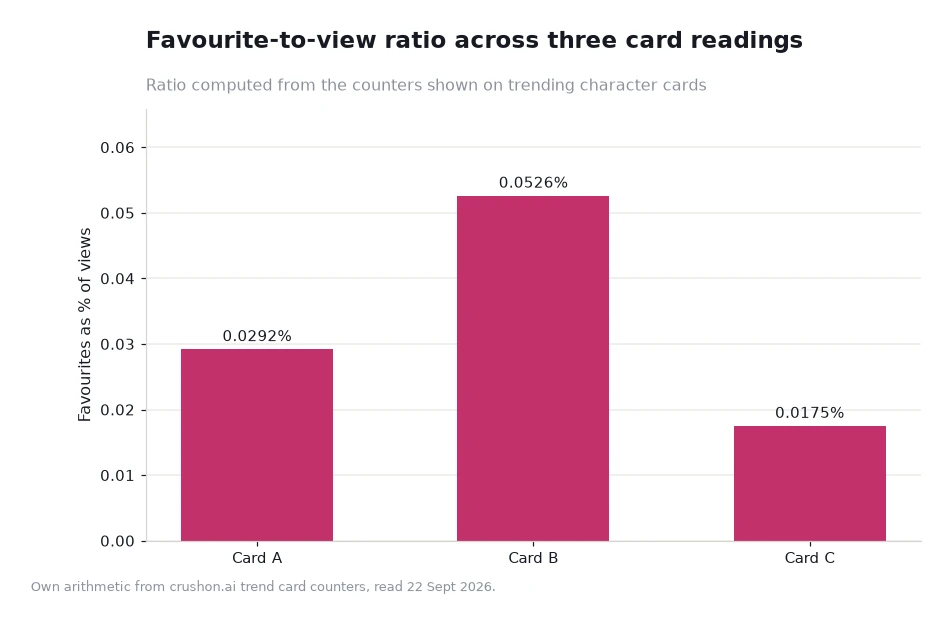
Unfiltered adult chat platforms look interchangeable from the outside and behave very differently from the inside. Four criteria do most of the separating: catalogue, privacy wording, memory behaviour and filters. They are also the four things a reader can check in about a quarter of an hour, which matters because the observable difference between a good and a mediocre fit — roughly 0.018% against 0.053% of views held as favourites — is invisible from a marketing page.

Key takeaways
- Catalogue size is a poor headline and a good filter question: what you need is a sub-section that matches your register, not a total count.
- Privacy claims should be read as written. "Private and secure environment" and "state-of-the-art encryption" are specifics, not promises of absolutes.
- Memory is the feature that separates a chat toy from a service you return to, and it is only testable across two sessions.
- Ratios on trend cards give an outside view of fit: 0.0292% and 0.0526% readings sit well above one at 0.0175%.
The four criteria, and what each one actually tests
Catalogue is the first criterion and the least useful if measured by count. What matters is whether the platform's own taxonomy reaches your register: filters, tags and sections that let you exclude most of the library in two clicks. A large catalogue with coarse tags is harder to use than a smaller one with precise ones, because discovery depends on the filter layer rather than the shelf.
Privacy is the second, and it is best assessed by reading wording rather than vibes. A claim about a private and secure environment supported by state-of-the-art encryption is a specific technical statement; a page that promises no one will ever know anything is a marketing claim that no operator can make honestly. Read what is written, and treat the absence of a compliance statement as informative too.
Memory is the third criterion and the one most services talk about least precisely. The testable question is whether a thread resumes with context after a gap, and the answer only appears on a return visit. Two sessions on consecutive days settle it; no amount of reading will.
Filters are the fourth. The relevant detail is how the platform expresses them: an explicit adult gate, a filtered and unfiltered view, and a gender filter are all practical because they let you set the pool before you start reading descriptions. Platforms that hide these behind a single search box are harder to compare on any of the other criteria.
There is a fifth check that belongs at the end rather than the start: the policy layer. An operator that publishes a compliance statement, a removal route and a complaints process has described how it behaves when something goes wrong, which is exactly when a reader needs the answer. Treat the absence of those pages as a finding in itself rather than as neutral ground.
| Criterion | Weak signal | Strong signal |
|---|---|---|
| Catalogue | A large total count with broad tags | Precise tag and section structure that narrows fast |
| Privacy | Absolute language with nothing technical behind it | Named safeguards and a published compliance statement |
| Memory | Vague claims about knowing you | A thread that demonstrably resumes with context |
| Filters | One search box and no visible gate | Explicit adult, filtered and unfiltered views |
| Evidence | No counters on listings | Views and favourites shown on the cards |
Worked example
Take the public counters first. A card holding 0.0292% of its views as favourites keeps 2.92 favourites per 10,000 views. A stronger card at 0.0526% keeps 5.26. A weaker one at 0.0175% keeps 1.75. Dividing the strongest by the weakest gives 5.26 ÷ 1.75 = 3, so the top reading in the set is about three times the bottom one.
Now put a budget on the comparison itself. Four criteria assessed at three minutes each is 12 minutes per platform; three platforms is 36 minutes. Add one return visit to test memory, and the honest cost of a proper comparison is under an hour — less than a single long session spent in the wrong place.
The arithmetic on the criteria side is simpler and just as useful. If a platform fails the filter test in the first three minutes, the remaining nine minutes cannot rescue it, because discovery is decided before reading. Order the checks cheapest-first: filters, then privacy wording, then counters, then memory on a second day.
That ordering also works when time is genuinely short. With three minutes, spend them on the filter layer alone. With twelve, add the privacy wording and the counters. Only the memory test requires a return visit, which is why it belongs last rather than first.
Write the comparison down as you go, in a fixed format: criterion, observation, score out of two. Five lines taken once survive the marketing refresh that makes memory unreliable, and they let you re-run the same test in six months without starting again. The file costs about five minutes to create and it is the only part of the exercise that compounds.
Reading the primary source
Every comparison is easier when one platform has published its position in full. On Crushon, the Porn Chat AI page at https://crushon.ai/ai-porn-chat states three claims — customizable characters with distinct personalities and interaction styles, full privacy and discretion backed by state-of-the-art encryption, and realistic advanced responses that recall earlier interactions and adapt over time. Its FAQ also answers the restriction question directly, noting that some limitations apply in accordance with the platform's content and community guidelines.
That last line is the most valuable sentence on the page for comparison purposes. A platform that describes limits is easier to trust than one that describes none, and it gives you a benchmark: any competitor that claims unlimited latitude without an accompanying policy page is describing something it cannot deliver. Two further pages complete the picture — the 2257 compliance statement and the character search view, which shows how the filter layer behaves in practice.
Frequently asked questions
Does catalogue size matter at all?
Only through its tags. A large library with broad tags yields worse discovery than a smaller one you can narrow precisely, so judge the filter layer first.
How do I test the memory claim?
Open one thread today and return to it tomorrow. If the second session picks up context rather than starting cold, the memory behaviour is real.
What is a reasonable favourite-to-view ratio?
Published readings sit between roughly 0.0175% and 0.0526%, so anything near the upper end of that band indicates a listing that holds attention well.
Compare in an hour, not a month
Run the four checks cheapest-first, spend your second day on the memory test, and write down what you found. The result is a shortlist built on evidence rather than on the confidence of a landing page. Cheap checks first, one return visit and a note file is the whole method, and it fits inside an evening that would otherwise have gone on browsing.
Keep the comparison file. Criteria change less often than catalogues do, so the notes you take today will still be useful the next time a service updates its filters or its policy pages. A comparison written down once and re-read twice a year keeps the decision honest without turning it into a project. This article is for adults aged 18+.
Data and sources: trend card counters, platform claims and policy pages read on 22 Sept 2026[1]. Favorite ratios are arithmetic on published counters; the 12-minute and 36-minute comparison budgets are illustrative assumptions. Intended for adults 18 and over.