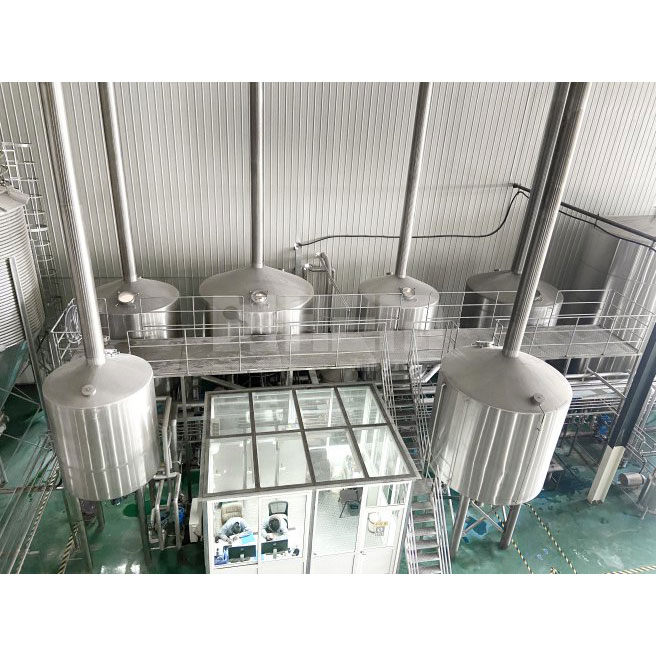
Quality brewing equipment matters because beer production depends on repeatable control of heat, pressure, flow, sanitation, and oxygen exposure. A 1,000 L batch that loses 3% during transfers gives up 30 L before packaging; over 200 batches, that becomes 6,000 L. Fermentation temperature errors of only 2–3°C can change yeast activity and flavor production, while poor cooling or inaccurate sensors can extend tank occupancy. Food-contact surfaces also need to tolerate repeated alkaline, acid, and sanitizer cycles. A well-built brewing system gives the brewer measurable control over product quality, batch yield, cleaning, utilities, and production time.
A commercial brewery is a sequence of connected processes rather than a collection of tanks. Milling changes particle size, mashing controls enzymatic conversion, lautering separates wort from grain, boiling sterilizes wort and develops bitterness, cooling prepares wort for yeast, and fermentation turns sugars into alcohol and carbon dioxide. A defect in one machine can affect every stage after it.
For a 1,000 L brewhouse producing 3 batches a day, a pump that adds 15 minutes to each transfer can consume more than 180 production hours over 240 brewing days. Equipment selection therefore affects labor scheduling as well as beer. As production increases, small differences in cleaning, heating, cooling, and transfer time become easier to measure in annual operating records.
A brewery does not need the most complicated equipment available. It needs vessels, pumps, controls, piping, and utilities sized for the actual process and capable of repeating the same process hundreds of times.
Mash control shows how equipment design reaches the finished beer. Brewers commonly work within roughly 62–70°C during saccharification, depending on recipe and desired fermentability. A temperature probe that reads 2°C away from the actual mash temperature can cause the brewer to hold a process at a different condition from the recipe specification.
Uniform heating matters as much as the sensor. Steam jackets, electric elements, vessel geometry, agitation, insulation, and control logic determine how evenly heat moves through the mash. A temperature reading from one point cannot describe a poorly mixed 2,000 L vessel if separate zones are several degrees apart.
That heating stage leads directly to wort separation. A lauter tun must allow liquid wort to leave while maintaining a grain bed that performs as a filter. False-bottom design, open area, rake geometry, wort velocity, and differential pressure can affect runoff speed and extract recovery.
If one brewhouse recovers 80% of the available extract while another consistently reaches 85%, the 5-percentage-point difference becomes significant over a full year. With 100 kg of malt per batch and 300 annual batches, the brewery processes 30 metric tons of malt, so modest extraction differences can materially change the amount of raw material required for the same beer volume.
| Equipment area | Measurement worth checking | Why it matters |
|---|---|---|
| Mash system | Temperature deviation | Alters conversion conditions |
| Lauter tun | Extract recovery % | Affects malt use and wort yield |
| Kettle | Heating rate and evaporation | Affects time and wort concentration |
| Heat exchanger | Wort outlet temperature | Affects yeast-pitching conditions |
| Fermenter | Temperature and pressure | Affects fermentation control |
| Packaging | Dissolved oxygen and fill volume | Affects packaged-beer stability |
Boiling adds another utility requirement. Commercial wort is commonly boiled for around 60 minutes, although recipe and equipment design can shorten or extend that period. Heat must be supplied consistently enough to maintain the required evaporation and process conditions without scorching product on heated surfaces.
The energy put into hot wort must then be removed before fermentation. A plate heat exchanger can cool wort from near boiling temperature to fermentation temperature in a single controlled transfer when its surface area, coolant flow, and temperature difference are properly sized. Undersizing the exchanger can slow cellar filling and increase cooling-water demand.
A brewery filling a 2,000 L fermenter in 40 minutes moves an average of about 50 L per minute. If the cooling system only handles 30 L per minute at the required outlet temperature, tank filling takes more than 60 minutes before cleaning and hose changes are counted. Production planning should therefore use real flow rates rather than vessel capacity alone.
Fermentation places different demands on the equipment. Yeast produces heat while metabolizing sugars, so a fermenter cannot rely on room temperature to control the beer. Cooling jackets, glycol supply temperature, jacket area, insulation, sensor placement, and control valves work together to remove heat from the liquid.
A 20 hL tank also has a different thermal behavior from a 5 hL tank because volume increases faster than external surface area as vessels become larger. Scaling a brewery is therefore not simply a matter of multiplying every dimension by 4. Cooling and heating calculations need to reflect the geometry and process load of the larger vessel.
Pressure adds another engineering requirement. Fermenters and bright beer tanks may be designed for operation under pressure, but the allowable working pressure depends on vessel construction, fittings, relief devices, fabrication standard, and local requirements. Pressure ratings should come from equipment documentation, not assumptions based on wall thickness or tank appearance.
Relief valves, pressure gauges, vacuum protection, clamps, gaskets, and ports are part of the vessel system. A pressure-rated tank is only as usable as the components connected to it.
Sanitation then becomes the link between mechanical design and microbiological control. FDA sanitary-design guidance calls for food-contact surfaces that are corrosion resistant, durable, smooth, nonabsorbent, nontoxic, and easy to clean. The 2022 FDA Food Code also defines cleanability in relation to material, construction, installation, and the ability to remove soil using normal cleaning methods.
Stainless steel is widely used because it meets many of those requirements when correctly fabricated. The alloy grade alone does not determine sanitary performance. Internal weld finishing, surface condition, drainability, gasket design, valve construction, and the absence of product traps can matter just as much during repeated cleaning cycles.
A tank with a polished shell but poorly finished internal welds can still retain organic material. The same problem occurs when a pipe section cannot drain, a valve contains a difficult-to-clean cavity, or a spray device does not reach part of the vessel wall. Cleaning performance therefore needs to be considered during equipment layout, not after installation.
Clean-in-place equipment can reduce disassembly, but CIP performance depends on chemical concentration, temperature, contact time, and mechanical action. A larger tank may need a different spray device or pump capacity than a smaller vessel. Simply circulating cleaner through a pipe does not confirm that every product-contact surface receives adequate coverage.
The FDA's HACCP guidance recommends sanitary equipment design, documented preventive maintenance, calibration schedules, and written cleaning procedures. Those practices matter in breweries because temperature probes, pressure instruments, flow devices, and dosing equipment can gradually move away from their original readings if they are never checked.
Utility use deserves the same level of measurement. Water is used for brewing, vessel rinsing, floor cleaning, packaging, cooling, and CIP. Electricity may run pumps, chillers, compressors, controls, and packaging machines, while gas or electricity supplies brewhouse heat.
A 10% reduction in water use is not automatically valuable if it produces longer cleaning cycles or poor rinse performance. The useful number is water consumed per unit of saleable beer while sanitation and product specifications remain within target. Recording liters of water, kWh of electricity, and cleaning chemicals per batch gives the brewery a usable operating baseline.
Beer losses also need to be measured in liters rather than treated as an unavoidable percentage. A 2,000 L batch with 4% combined loss through trub, yeast removal, transfers, and packaging yields 1,920 L. At 7% loss, output falls to 1,860 L, leaving a 60 L difference from the same brewhouse volume.
Across 250 batches, that 3-percentage-point gap represents 15,000 L of beer. Tank geometry, outlet position, transfer practices, hose volume, centrifugation or filtration choices, packaging setup, and operator procedures can all affect how much finished product leaves the brewery.
Oxygen control becomes more important once fermentation is complete. Pumps, loose connections, open transfers, tank headspace, packaging equipment, and poor purging practices can introduce oxygen after yeast has finished much of its protective work. Equipment that allows closed transfers and controlled gas handling gives brewers more control over exposure.
Cold-side equipment should therefore be assessed as one connected path from fermenter to package. A high-specification fermenter provides limited benefit when beer passes through poorly maintained hoses, unsuitable pumps, or packaging equipment with inconsistent purging immediately afterward.
The Brewers Association's 2026 Draught Beer Quality Manual continues to treat temperature, gas pressure, cleaning, and system design as practical quality-control variables. Its retailer guidance specifies beer temperatures around 36–38°F and cleaning intervals of 7–14 days for draught lines, illustrating how equipment conditions remain relevant even after beer leaves the production tank.
Reliability also affects usable brewery capacity. A brewhouse designed for 3 batches per day cannot deliver that schedule when heating elements, steam valves, pumps, chillers, or controls require frequent unplanned repair. Maintenance access, spare-part availability, standard component sizes, electrical documentation, and clear piping drawings deserve attention before purchase.
A well-planned craft brewery system should therefore be evaluated as a complete production line. Brewhouse output must fit fermentation capacity; fermentation capacity must fit conditioning time; glycol capacity must support the number of tanks cooling at once; pumps must provide suitable flow without excessive shear or foaming; packaging speed must match weekly production.
For example, a brewery producing 10 hL per brew and brewing 8 times per week creates 80 hL of wort. If average tank occupancy is 14 days, at least two weeks of fermentation capacity is already committed before production growth, cleaning windows, seasonal products, or longer-conditioning beers are considered.
The same calculation can expose unnecessary spending. Installing 200 hL of fermentation capacity beside a brewhouse that can only produce 40 hL per week may leave tanks unused for long periods. Buying by vessel count alone does not show whether the plant is balanced.
Automation should be treated in the same practical way. A brewery running 1 batch per day may work efficiently with manual valves and straightforward temperature controllers, while a plant running 4 or 5 batches per day can gain more from automated sequences, recipe control, valve position feedback, alarm history, and production data logging.
Automation does not repair poor mechanical design. A computer-controlled valve still performs badly if pipe routing traps product or if a temperature sensor sits where it does not represent the process. Mechanical layout, sanitary construction, instrumentation, and software need to support the same production method.
Equipment purchasing also extends beyond the tanks visible in a quotation. Buyers should compare pumps, motors, valves, heat exchangers, controls, sensors, pressure devices, platforms, piping, glycol equipment, CIP equipment, electrical panels, documentation, installation work, commissioning, training, warranty terms, and spare parts.
Two quotations separated by 15% in purchase price may cover very different scopes. One may include field piping, commissioning, insulation, controls, and spare gaskets, while the other covers vessels alone. Comparing line-by-line specifications gives a more accurate picture than comparing the final equipment price.
Material certificates, pressure documentation where applicable, electrical drawings, P&IDs, component data sheets, operating manuals, weld records when specified, and recommended maintenance schedules can also reduce uncertainty after installation. Documentation becomes more useful as staff changes and the brewery adds equipment in later years.
Quality brewing equipment is therefore measured through repeatability: temperature stays within the specified range, vessels clean consistently, pumps deliver the expected flow, pressure systems operate within documented limits, beer losses can be measured, and replacement components remain available. A brewery running 200–300 batches a year has enough repetition for small equipment differences to become large annual differences in beer volume, labor hours, water, energy, and production availability.